May 4, 2026
Something I’ve been noticing more and more in practice is how easily accountability becomes a bit blurred in a business.
The work is being done, the processes are there, the compliance officer is involved somewhere along the line, and yet if you pause for a moment and really ask where accountability sits, the answer is not always as clear as it should be.
For a long time, many businesses have operated quite comfortably like this. Work is delegated, processes are documented, compliance is “managed” in some form or another, and as long as everything appears to be in place, there is a general sense that things are under control.
Until something goes wrong…
And that is usually the point where the conversation shifts quite quickly. It moves away from whether the process existed or whether it was followed, and lands on a much more direct and uncomfortable question around who is actually accountable for what has happened.
That is where things tend to become a bit uneasy.
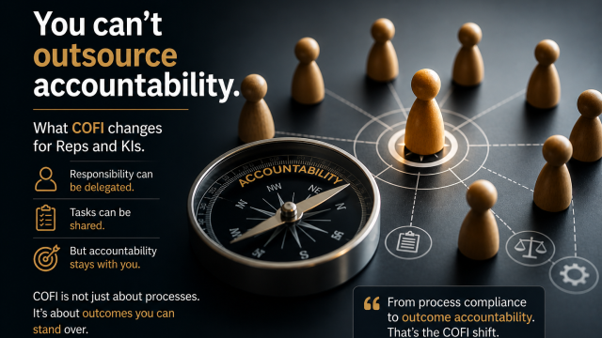
COFI brings that discomfort much closer to the surface. The shift is not just about strengthening compliance frameworks or tightening up processes. It is about making accountability far more visible, and far harder to sidestep.
There is a definite move away from relying on the comfort of having a process in place, towards being able to stand over the outcome that process produces. And those are not the same thing, even though they are often treated as if they are.
For Reps and Key Individuals, this matters more than most.
Because while tasks can be delegated quite easily, and responsibility can be shared across a team, accountability has a way of staying exactly where it started. It does not move to the administrator who captured the information, and it does not sit with the compliance officer who reviewed the file. It remains with the person whose role carries that accountability, whether that feels comfortable or not.
I have seen, over the years, that the words “ownership” and “accountability” can trigger quite a strong reaction. Not always openly, but it shows up. There is often a natural pull towards the parts of a role that feel clearer, more familiar, or even just more enjoyable, while the rest quietly becomes less defined and, in some cases, someone else’s problem.
That is usually where things start to unravel, although it is rarely obvious in the moment.
Under COFI, that becomes much harder to ignore, because accountability is sitting much closer to the centre of what makes a business trustworthy in the first place. From a client’s perspective, the expectation is simple. They assume that someone is taking responsibility for making sure things are done properly and consistently, whether they see that structure or not.
In practice, this means businesses need to start asking slightly different questions. It is less about whether the right policies and processes exist, and more about whether it is genuinely clear who is accountable for making sure those processes are followed, properly, every time.
Because if that answer is vague, the risk is not theoretical. It is already present in how the business is operating.
COFI is not introducing accountability into the system. It is simply making it far more visible when it was never fully in place to begin with.