May 8, 2026
One of the most common frustrations I hear in businesses is this:
“We’ve already trained the team on this.”
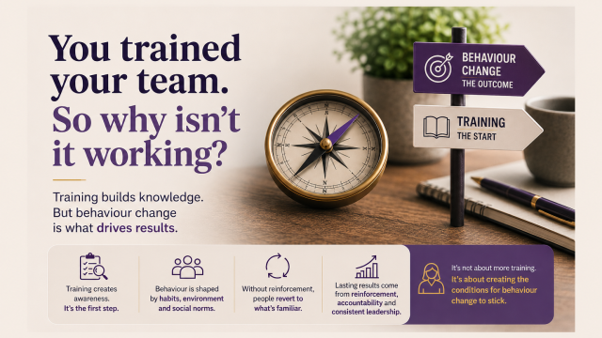
And yet, a few months later, the same issues start appearing again: Processes are followed inconsistently. Steps are skipped. The “old way” quietly creeps back in. At that point, the assumption is usually that the training did not work, or that the team simply is not taking it seriously enough. But behavioural research tells us something important here: training and behaviour change are not the same thing.
And in practice, that gap is often much bigger than businesses realise.
Most training focuses on knowledge transfer. People are shown what the process is, why it matters, and what they are expected to do differently going forward. The problem is that knowledge alone rarely changes long-term behaviour.
Human beings are heavily shaped by habit, repetition, environment, social reinforcement, and pressure. In the moment, people naturally fall back towards what feels familiar, efficient, or cognitively easier, especially when workloads increase or deadlines become tight.
That is why businesses often see strong adherence immediately after training, followed by gradual drift over time. Not because the team is unwilling. Because behaviour defaults back to what is reinforced daily.
There is also a psychological element that businesses often underestimate. Research into workplace learning and psychological safety consistently shows that people are far more likely to adopt and maintain new behaviours when the environment around them supports it.
If someone is trained on a new process, but:
- their manager ignores it,
- shortcuts are tolerated,
- speed is rewarded over consistency,
- or nobody follows up on whether the process is actually being applied,
the brain receives a very different message from the one delivered in the training session. The business may say: “This is important.” But the day-to-day environment says: “This is optional.” And over time, people follow the environment, not the slide deck.
There is also the simple reality of how memory works. Research around the “forgetting curve”, first explored by Hermann Ebbinghaus and reinforced repeatedly in later learning studies, shows that information naturally fades unless it is reinforced over time. In other words, a single training session was never likely to create lasting operational consistency on its own. Without reinforcement, repetition, visibility, feedback, and practical application, people forget. Or they remember the theory, but fail to consistently apply it in practice. Those are two very different things.
What makes this even more difficult in operational environments is that process drift rarely announces itself. It happens slowly: A shortcut here. A workaround there. A slightly different interpretation of the same process depending on who is doing it.
Most of these changes are introduced with good intentions. Someone is trying to save time, solve a problem quickly, or reduce friction in a busy moment. Individually, they seem insignificant. But over time, those small deviations accumulate. Five years later, the business can find itself operating very differently from the process that originally existed on paper. And often nobody can quite pinpoint when the shift happened.
This is why implementation requires far more than training:
- It requires reinforcement.
- It requires visible ownership.
- It requires managers and leadership teams to consistently model the behaviour themselves.
- And perhaps most importantly, it requires businesses to understand that behaviour change is not an event. It is a process.
One training session may create awareness. The environment that follows determines whether the behaviour survives.
In practice, the businesses that achieve consistency are usually not the ones with the most sophisticated training material. They are the ones that create operational environments where:
- expectations remain visible,
- accountability is clear,
- reinforcement happens consistently,
- and the process becomes part of how work naturally gets done.
That is a very different thing from simply telling people what they should do.
Perhaps the better question for businesses is no longer: “Did we train the team?”
But rather: “What is happening in the environment after the training is over?”
Because that is usually where the real answer sits.