April 28, 2026
Most financial planning practices don’t feel unstable. In fact, many feel quite the opposite. Clients are being serviced, the team knows what they’re doing, and the business is moving forward.
From the outside, everything looks… fine. And in many cases, it is fine… Until something shifts.
A key person is unavailable. The business grows a little faster than expected. A new process is introduced. Or pressure simply increases.
And suddenly, things that seemed to work quite comfortably start to feel a bit more difficult. Things slow down. Decisions take longer. Questions start getting escalated. And small inconsistencies begin to show up.
Nothing is obviously broken. The business simply isn’t as structurally strong as it appears.
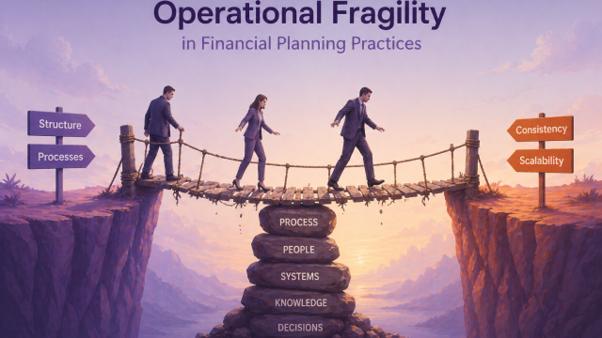
This is what I refer to as Operational Fragility.
Operational Fragility is not always obvious. It doesn’t announce itself. In fact, it often sits quietly inside businesses that are doing well. The business functions. The team copes. Clients are looked after.
But underneath that, there are small dependencies, small gaps, and small inconsistencies that only really become visible when something changes. And that’s usually when the real picture starts to emerge.
Fragility rarely comes from one big issue. It builds up slowly.
A process that was never properly embedded. A policy that exists, but isn’t really used. A team member who “just knows how things work.” A founder or director who steps in when things feel uncertain.
Individually, none of these feel like a problem. Together, they create a business that relies on the right conditions to function smoothly. When those conditions hold, everything feels stable. When they don’t… the cracks start to show.
If you look closely, many of these patterns will feel familiar. Frameworks exist, but don’t always translate into how work is done. Processes are followed differently depending on who is involved. Decisions are made through experience rather than structure. And over time, certain individuals become central to how things function.
None of this stops the business from operating. But it does shape how resilient that business actually is.
This is where an important distinction needs to be made. Stability is not the same as strength. A business can feel stable simply because:
- the right people are in place
- the volume is manageable
- the environment hasn’t been disrupted
But that doesn’t mean it is structurally strong. Strength shows up differently. It shows up in consistency. In clarity. In the ability of the business to operate without constant intervention. In how well the business adapts when something changes. And, perhaps most importantly, in how the business functions when the usual conditions are no longer there.
One of the more telling signs of Operational Fragility is how a business responds to pressure.
Not extreme pressure. Just normal, everyday pressure. A busy period. A team member on leave. An increase in workload.
In a structurally strong business, the system absorbs that pressure. In a fragile one, the pressure tends to move elsewhere, usually to people.
The founder becomes more involved. Decisions get escalated. The team becomes more cautious. And slowly, the business starts relying more heavily on individuals again.
Addressing Operational Fragility doesn’t require a complete rebuild. It does require a shift in focus. Less attention on how things appear, and more attention on how they actually work. Looking closely at where:
- processes are inconsistent
- knowledge sits in people rather than in structure
- decision-making is unclear
- and frameworks exist, but are not embedded
And then doing the work of aligning those elements properly, not by adding more layers, but by making what already exists… work better.
Ultimately, the goal is to build a business that continues to function even when conditions change. Because conditions will change. People will be unavailable. Pressure will increase. The business will evolve. And that’s where the difference becomes clear.
Some businesses absorb that change. Others feel it immediately. And this is often where I find myself working with financial planning practices. Because, even when nothing has gone wrong, sometimes what used to work… is simply no longer enough. And that’s where the real work begins.
A business does not become fragile overnight. But over time, if the underlying structures are not strengthened… it quietly becomes more dependent, more reactive, and more exposed than it realises.