Aug 21, 2026
Practice owners often say they want a self-managing team. What they usually mean is that they want people who take initiative, make sensible decisions, solve problems without being chased and do not bring every tiny issue back to the owner. They want to get out of the weeds. They want capacity back. They want to stop being the person every decision, question and exception eventually lands on.
All of that is reasonable. The problem starts when “self-managing” quietly becomes “left to figure it out”.
A team can work independently, but it cannot work in a vacuum.
Trust matters, but trust on its own is not enough. If people are expected to take ownership, they still need clarity, structure, authority, information and feedback. Without those things, what looks like empowerment from the owner’s side can feel very different to the employee on the receiving end.
Delegation and abdication are not the same thing
Many practice owners are attracted to the idea of a self-managing team because they are tired… As the business grows, the owner often becomes the senior adviser, relationship owner, problem solver, quality checker, decision-maker and keeper of the institutional knowledge. Eventually they reach the point where they simply need things off their desk. That is usually when delegation begins.
But sometimes the conversation sounds less like: “Here is what you own, this is what good looks like, these are the decisions you can make and this is when I need you to involve me.”
And more like: “This is yours now. Please sort it out.”
That is where delegation can quietly become abdication. Delegation means transferring ownership with the authority, context and support required to succeed. Abdication means transferring the problem. The distinction matters, because responsibility without authority is not empowerment. It is exposure.
Empowered employees are not unsupported employees
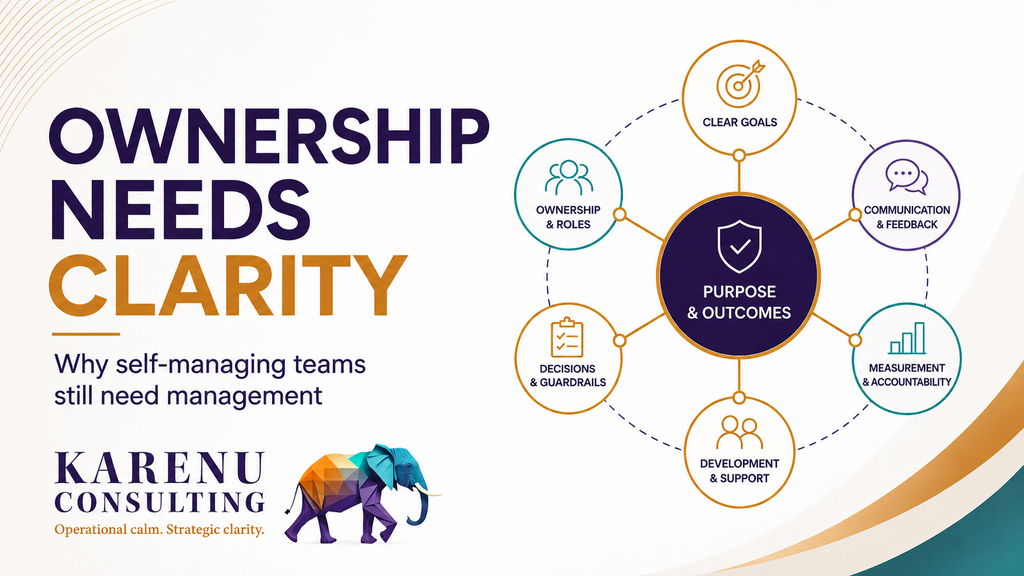
An empowered employee should be able to answer some very basic questions:
- What am I responsible for?
- What decisions can I make myself?
- When do I need to escalate something?
- What does a good outcome look like?
- Where do I find the information, process or system I need to do the job properly?
If those things are unclear, the employee has two options: They can keep checking with the owner, which creates the very dependency the owner was trying to remove. Or they can make their best guess. Sometimes the guess will be right. Sometimes it will become tomorrow’s compliance incident!
Good structure does not reduce autonomy. It creates safe autonomy. That is also the difference between management and micromanagement. Micromanagement is controlling how every task is completed, constantly checking progress, redoing people’s work and requiring approval for things that should sit comfortably within someone’s role. Good management is different. It means agreeing the outcome, setting boundaries, making decision rights clear, checking progress at sensible intervals and being available when something genuinely needs escalation. The irony is that more clarity upfront usually means less supervision later.
The warning signs are usually already there
When self-management starts breaking down, businesses often do not experience one dramatic failure. They experience dozens of small frustrations:
- The same questions keep coming back to the owner.
- Work sits because nobody is quite sure who is allowed to make the decision.
- Employees constantly ask, “Can I just check something?”
- Two people assume the other person owns a task.
- Or everyone owns it, which usually means nobody really does.
- The process changes depending on which employee handles the client.
- The same mistakes are corrected repeatedly.
- Senior employees quietly become the workaround for unclear processes.
- People become nervous about making decisions.
- Or, at the other extreme, people make decisions they were never authorised to make.
These are not always people problems. Very often they are clarity problems, process problems, authority problems or management problems that are showing up through people.
One of the simplest tests is to imagine the owner being away for two weeks. If everything stops, you have dependency. If everything becomes the Wild West, you have another problem entirely. Neither is self-management.
Clients eventually feel the cracks
Internal operational ambiguity rarely stays internal. Clients experience it through repeated requests for the same information, unclear handovers, inconsistent answers, slow responses and the familiar phrase: “I’ll just have to check with the adviser.”
Individually, these moments may seem small. Collectively, they tell the client something about how well the business operates.
The risk also goes beyond service. Where ownership is unclear, documents can be missed, reviews can fall through the cracks, information may not be captured correctly, tasks may not be recorded and exceptions may not be escalated. Operational ambiguity eventually becomes operational and compliance risk.
It also has a direct impact on capacity. Poor delegation does not create capacity. It creates rework, interruptions, checking, correcting and escalation. The owner tries to step away and somehow ends up more involved than before.
Good management does not require corporate bureaucracy
A six-person financial planning practice does not need a 200-page management framework. It does need a few things to be very clear.
First, people need clarity about roles. Not simply job titles, but real ownership.
- What am I accountable for?
- What do I own from beginning to end?
- Where am I supporting someone else rather than being responsible for the outcome?
Second, decision-making authority needs to be explicit. A very simple model can work surprisingly well:
- Decide yourself.
- Decide and inform me.
- Discuss before deciding.
Those three categories can remove a huge amount of unnecessary escalation because people know where their authority begins and ends.
Third, there needs to be some kind of operating rhythm.
That may include a weekly team meeting, a short operational check-in, one-on-ones or regular exception reporting. The point is not to create more meetings. The point is to create predictable opportunities to ask:
- What is stuck?
- What needs a decision?
- What has changed?
- Where are we seeing the same problem repeatedly?
If your weekly operations meeting consists of everyone reading their task list aloud for an hour, however, we may need another conversation.
Finally, the business needs feedback loops. When something keeps going wrong, correcting the individual instance is not enough. The more useful question is: Is this a person problem, a clarity problem, a process problem or a system problem? The answer changes what you should fix.
Start with the friction, not the organogram
If a practice owner wants to improve this, I would not start by rewriting every job description. Start with one recurring source of frustration. Ask your team: “Where do you regularly need to come back to me because you are unsure what you can decide?” The answers will probably show you where some of your real bottlenecks sit.
Choose one recurring decision, unclear handover, process or responsibility and clarify five things:
- Who owns it?
- What outcome are they responsible for?
- What can they decide themselves?
- When must they escalate?
- What information or tools do they need?
Then test it…
You will know empowerment is improving when people make faster, more consistent decisions, unnecessary escalations reduce, recurring mistakes start disappearing and employees begin identifying problems before management does.
One of the clearest signs of maturity is how people bring problems forward. A dependent employee asks: “What should I do?” A developing employee says: “I think we should do this. What do you think?” An empowered employee can say: “I did this because it falls within the agreed boundaries. Here is the outcome.”
That is not a team operating without management. It is a team benefiting from good management.
Trust is the starting point, not the operating model
You should trust good people. But trust cannot substitute for clarity. It cannot define responsibility. It cannot establish decision rights. It cannot document a process. And it cannot tell someone where their authority ends.
A self-managing team still needs management. It simply needs a different kind of management. The goal is not to build a team that never needs the owner. The goal is to build a team that does not need the owner for everything.