July 27, 2026
I recently delivered a lecture for Moonstone on something I see quite often in financial planning practices: the tendency to overcomplicate advice when the client is actually asking for clarity. The session was aimed at helping planners think more practically about advice sequencing, especially how to start with the client’s immediate concern, solve that properly, and then guide the client towards the other important planning areas that may also need attention. It is one of those topics that sounds simple in theory, but in practice, it is where many advice processes start to wobble.
There is something I see often in financial planning practices, especially with younger planners who are still finding their feet, but let’s be honest, experienced planners are not magically immune to this either!
A client comes in with a fairly specific concern. They have had a baby and want to know whether their family will be okay if something happens to them. Or they are changing jobs and do not know what to do with their pension. Or they have inherited money and feel nervous about making a mistake. Or they are nearing retirement and suddenly the theoretical “one day” has become “oh dear, this is now quite soon.”
The client is usually asking something quite human:
-
- Will my family be okay?
-
- Am I making the right decision?
-
- Can I afford this?
-
- What happens if something goes wrong?
-
- Have I missed something important?
And then we, as a profession, sometimes respond with enough graphs, projections, comparisons, scenarios, tables, disclosures, calculations and technically correct explanations to make a perfectly intelligent adult feel like they have accidentally walked into the wrong exam venue!

I say “we” deliberately, because this is not normally done from a bad place. Most planners are not trying to confuse clients. They are not sitting behind their laptops thinking, “Excellent, let me now bury this poor person under projections until they lose the will to live.” At least, I sincerely hope not. It usually comes from good intentions. The planner wants to be thorough. They want to prove they have considered everything. They want to give proper advice. They want the file to stand up to scrutiny. They want to show value.
The problem is that clients do not always experience more information as more value. Sometimes they experience it as noise.
And when a client is overwhelmed, they may nod politely, thank you for your time, take the report home, place it somewhere “safe”, and then do absolutely nothing. And it’s rarely about the advice being wrong or the planner not trying hard enough. It’s usually just that the client did not leave with enough clarity about the actual decision in front of them. That is the part we need to pay attention to.
Because a client does not come to a financial planner because they want to admire our working papers. They come because they need help making a decision, solving a problem, protecting someone, preparing for something, or understanding what to do next.
The skill is not only in doing the analysis. The skill is in knowing how to translate that analysis into advice the client can actually use. And that starts with solving the first problem first… not the only problem, not the easiest product opportunity, not the whole financial universe in one sitting… The first problem. The reason the client is sitting in front of you now.
If a client comes to you because they are worried about whether their family will be financially okay if they die or become disabled, then that is where the conversation needs to start. Yes, you may pick up that they do not have a will. Yes, you may notice that their retirement provision is not where it should be. Yes, their emergency fund may be looking a little anaemic. Yes, their beneficiary nominations may need attention. Those things matter. They should not be ignored. But they also do not all need to be thrown at the client immediately like a planning grenade!
There is a difference between identifying an issue and making it the client’s immediate decision. That difference is where a lot of advice either becomes useful, or becomes overwhelming.
The planner’s job is to start where the client is, understand the broader context, and then guide the client to where they also need to go. That “also” matters. We are not reducing advice to a narrow product conversation. We are not saying, “Client asked for cover, therefore only talk about cover and ignore everything else.” That would be lazy. But we are also not saying, “Client asked for cover, therefore let us immediately produce risk, retirement, estate, education, tax, investment and cash flow planning in one glorious avalanche.”
That may feel comprehensive to the planner. It may feel like being hit by a filing cabinet to the client!
I think one reason this happens is that planners often confuse comprehensive thinking with comprehensive delivery. You absolutely should think broadly. You should understand the client’s situation properly. You should test assumptions. You should consider consequences. You should identify gaps. You should look for risks the client may not have seen. That is part of your professional role. But comprehensive thinking does not mean the client needs to receive everything at once.
Behind the scenes, the planner may need to run scenarios, compare options, test affordability, look at trade-offs, check existing cover, consider employee benefits, think about liquidity, and make sure the recommendation is suitable. That is the work. Do the work. Please do the work. This is not a motivational poster for shallow advice. But do not make the client carry the full weight of your analysis.
The client-facing conversation should be clear, focused and decision-friendly. The client should understand what you recommend, why it makes sense, what the trade-offs are, what they need to decide now, and what still needs attention later. That is not dumbing down advice. That is making advice usable.
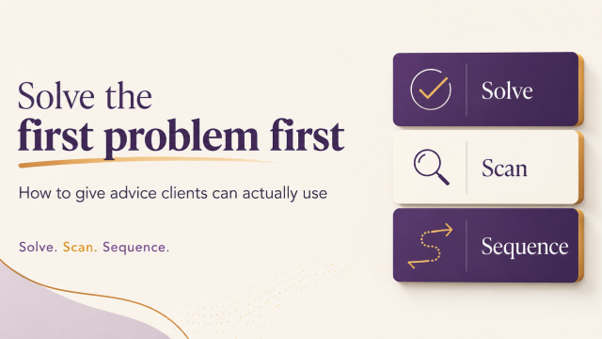
There is a very practical way to think about this: solve, scan, sequence.
Solve the immediate problem. Scan for related advice areas. Sequence the next steps.
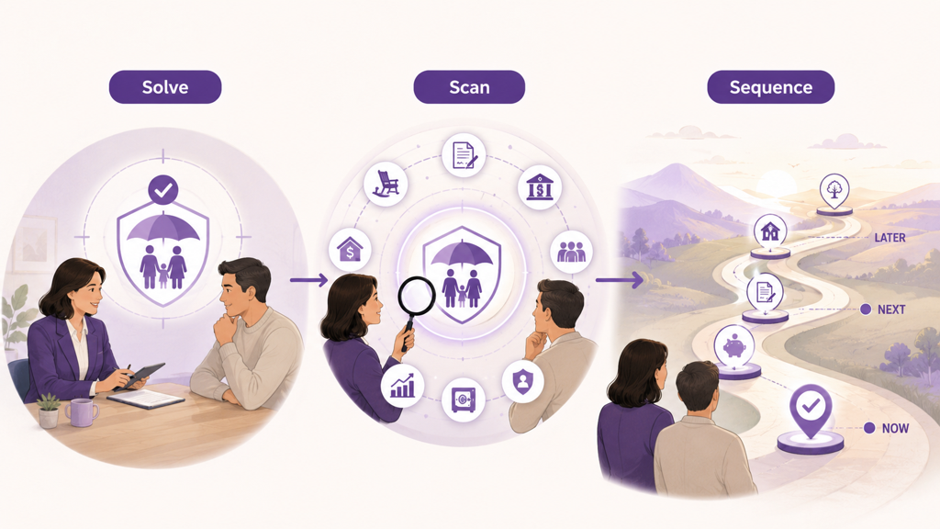
So, if the immediate problem is protection for the family, solve that properly. Clarify what the client is worried about. Check the facts. Understand the dependants, the debt, the income need, the affordability, the existing cover, the gaps, the assumptions. Then make the recommendation in plain language. Help the client understand the decision they need to make.
While doing that, scan for other advice areas. Maybe the client needs an updated will. Maybe there is an estate liquidity issue. Maybe retirement contributions are low. Maybe there is no emergency fund. Maybe the client does not understand investment risk. Maybe there are beneficiary nominations that need to be reviewed. Flag those things. They matter. But then sequence them.
Help the client understand what needs attention now, what should happen next, what can be reviewed later, and what may need a separate advice conversation. The “future” does not have to mean five years from now. It may mean next week. It may mean after the risk cover has been implemented. It may mean at the next review. The point is not to delay important advice. The point is to give the client enough structure to absorb it and act on it.
There is a very different client experience between these two approaches: In the first, the client comes in worried about protecting her family, and leaves with a massive report covering life cover, disability cover, severe illness cover, retirement planning, estate planning, education planning, investments, tax efficiency, product comparisons and multiple graphs and projections. Somewhere in there is probably a perfectly good recommendation, but it is buried under everything else the planner wanted to show.
In the second, the planner says something like: “Your immediate concern is whether your family would be financially okay if something happens to you. That is what we are going to deal with first. I am going to gather broader information because it affects the quality of the advice, and because it may highlight other planning areas we should come back to. But the first recommendation will focus on your protection need. Anything else I pick up, I will flag clearly and we can agree what to deal with next.”
That small shift changes the whole tone. The client knows what is happening. The client knows why broader information is being gathered. The client knows the first decision is focused. The client also knows the planner is not ignoring the bigger picture. That is good advice. It is also good relationship management.
Because when you solve the first problem well, you earn the right to guide the client into the next conversation. You are no longer trying to force every possible planning area into the first meeting. You are building an advice journey the client can actually follow.
The same principle applies to reports. A report is not a storage facility for every thought you have had. It is not where every calculation goes to retire. A useful advice report should make the advice easier to understand, not harder. It should help the client see what they asked for, what information was considered, what issue is being solved now, what you recommend, why it is suitable, what they need to decide, what else you identified, and what should be dealt with next.
That does not mean the report becomes vague. It means it becomes focused.
One section I think many advice reports could benefit from is something along the lines of: “Important future planning points identified.”
That section allows the planner to say, for example: The current advice focus is risk cover for death, disability and severe illness. During the advice process, we also identified that the client does not have an updated will, retirement contributions may be insufficient, emergency savings are limited, and beneficiary nominations should be reviewed. Recommended next step: once the risk cover has been implemented, schedule a retirement planning discussion and estate planning review.
That is clean. It is practical. It documents the broader thinking without hijacking the current advice. It also helps with scope. And scope, properly used, is not there to make the advice smaller. It is there to make the advice clearer.
The client should know what advice is being provided now, what information was considered, what is outside the current scope, what limitations apply, what further advice is recommended, and what they have chosen to proceed with or defer.
This protects the client. It protects the planner. It also prevents that horrible situation where a file looks impressively comprehensive, but nobody can clearly tell what problem the advice was meant to solve. And this is where I think we sometimes need to be honest with ourselves as a profession: Some of our complexity is not for the client… sometimes it is for us.
It makes us feel safer. It makes us feel more professional. It makes us feel like we have covered everything. It gives us something tangible to show. It may even look impressive inside a practice. But if the client cannot explain the recommendation back to you in plain language, something has gone wrong. Not necessarily with the advice itself, but with the way it has been delivered.
Before preparing advice, it may be worth pausing and asking:
-
- What did the client actually ask for?
-
- What is the immediate decision they need to make?
-
- What information do I need to advise properly?
-
- What have I identified that is relevant but not urgent?
-
- What must be addressed now?
-
- What should be flagged for later?
-
- Am I preparing this report for the client, or for my own need to prove I did the work?
-
- Can the client explain the recommendation back to me in plain language?
-
- Have I clearly documented the scope?
-
- Have I created a sensible next step?
Those are not academic questions. They are practical ones. They are the questions that keep advice from becoming a technical performance and bring it back to what the client actually needs.
Because clients do not need us to show them everything we know. They need us to help them understand what matters, what decision they need to make, and what comes next.
Start with the question. Solve the first problem. Scan for what else matters. Sequence the advice. And give the client something they can actually use.
