April 7, 2026
Most financial planning practices are compliant. At least… on paper.
If the Implementation Gap is the distance between knowing and doing, Compliance Theatre is what happens when we convince ourselves that knowing is enough.
In the financial planning profession, compliance is rarely ignored. In fact, most practices take it very seriously. Policies are written. Frameworks are put in place. Documents are created. External compliance officers are engaged.
On paper, everything looks as it should. And yet… when you spend time inside a practice, or speak to the people actually doing the work, a different picture often starts to emerge.
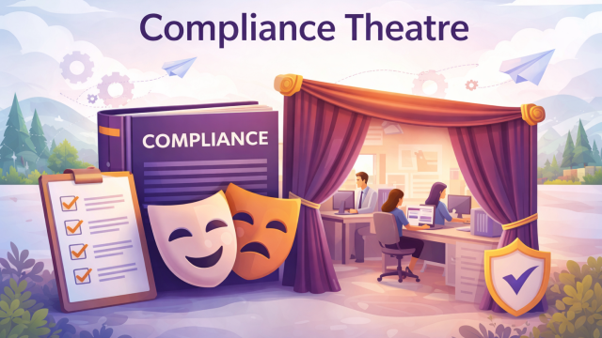
This is what I refer to as Compliance Theatre. Compliance that exists in form… but not in function.
Most firms can produce their compliance documentation when needed: they have the manuals, they have the policies, and they have the required structures in place. But when you look at how the business actually operates day to day, those frameworks are not always reflected in the way work gets done…
Processes are followed because “that’s how we’ve always done it,” not because they align with documented procedures. Staff members are often unaware of the detail contained in policies, or how those policies should guide their role. Decisions are made based on experience and habit, rather than within a clearly defined governance structure.
So while the documentation exists, it is not always embedded into the business itself. In many cases, the business is not operating according to its compliance framework… it is operating around it.
Compliance Theatre is not usually intentional.
It doesn’t happen because firms are trying to avoid compliance. In most cases, it happens because compliance has been built alongside the business, rather than into it.
Policies are developed as separate documents. Processes evolve organically. Teams find ways of working that are efficient for them.
But those two worlds don’t always align, and over time, a gap forms between what is written… and what is actually done.
One of the most telling signs of Compliance Theatre is when you ask a simple question: “How does this process work in your business?” And the answer you receive depends on who you ask. The adviser explains it one way. The administrator explains it another. The paraplanner has their own version. And none of them quite match what is documented. That inconsistency is where the real risk sits.
The challenge with Compliance Theatre is that it often goes unnoticed. From the outside, the business appears compliant: the documents are in place, and the required structures exist.
But because those frameworks are not embedded into the daily operation of the business, compliance becomes inconsistent. It depends on individuals. It depends on memory. It depends on experience. And that is where things start to become fragile.
Over time, this creates pressure in the business. New staff struggle to understand how things should be done. Training becomes informal and inconsistent. Founders or key individuals become the “holders” of knowledge. And when something goes wrong, it becomes difficult to trace whether the issue lies in the process… or in how it was followed.
Addressing Compliance Theatre does not require more documentation. In fact, most firms already have more than enough. What it requires is alignment. Alignment between:
- what is written
- what is understood
- and what is actually done
It requires taking compliance frameworks and embedding them into the way the business operates. Into workflows. Into roles. Into decision-making.
So that compliance is not something that sits on top of the business, but something that is part of how the business naturally functions.
Real compliance is not demonstrated by the presence of documents, it is demonstrated by consistency in how a business operates. And that only happens when compliance moves beyond paper… and into practice.
This is often where I find myself working with financial planning practices. Not creating more frameworks, but helping align what already exists with how the business actually runs.
Because the goal is not compliance that looks right. It is compliance that holds up… in the day-to-day.