March 17, 2026
The financial planning industry does not lack frameworks or guidance. What many practices struggle with is implementation.
In the financial planning industry there is certainly no shortage of knowledge.
Advisers attend CPD sessions, participate in webinars, download templates, read industry articles and engage with regulatory guidance. The information is there. The frameworks exist. The expectations are clear.
And yet, many practices still struggle to translate all of that into something that actually works inside their own businesses.
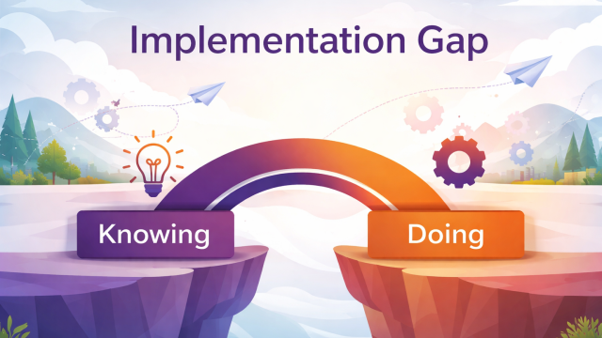
This is what I often refer to as the implementation gap.
It is the space between understanding what needs to be done and being able to integrate it into the daily workings of a practice.
Most firms know what good governance should look like. They know what compliant processes should include. They understand the importance of documented procedures and operational structure.
But knowing something and implementing it are two very different things.
In practice, what I often see is that practices gather knowledge over time. They accumulate policies, templates, procedures and guidance. These pieces are usually created with good intentions. They reflect best practice. They tick the right boxes.
But when you look more closely at how the business actually operates day to day, those frameworks are often sitting alongside the business rather than inside it.
Policies exist, but staff do not work from them. Processes are documented, but they are not embedded in workflows. Governance structures are defined, but decision making still happens informally.
The result is a business that appears structured on paper, but functions very differently in reality.
The implementation gap does not exist because advisers are unwilling to do the work. In most cases, the opposite is true. Practice owners are investing time and resources into improving their businesses. They are attending training, engaging with consultants and trying to adopt better practices.
The real challenge lies in translating those ideas into something that fits the specific structure, people and workflow of a particular firm.
Every advice practice is slightly different. Different team structures. Different client bases. Different operational histories.
A template or framework can provide direction, but it rarely drops neatly into place without some level of interpretation and adjustment.
Bridging the implementation gap requires something slightly different from more information or more templates.
It requires breaking complex frameworks down into steps that make sense for the business as it actually operates.
It requires translating theory into process. Guidance into workflow. Policies into behaviours.
When that happens, governance and compliance stop feeling like additional burdens placed on top of the business. Instead, they become part of how the business naturally functions.
And that is where the real value lies.
Not in frameworks that exist on paper, but in frameworks that actually work in practice.
This implementation gap is exactly the space where much of my work with financial planning practices sits.
At Karenu Consulting, the focus is not on adding more frameworks to the pile, but on helping firms translate governance, compliance and operational ideas into frameworks that work in practice.