April 13, 2026
There’s a recurring pattern I see across many financial planning practices: A junior adviser joins the business with potential. There’s energy, intent, and a genuine desire to make it work from both sides.
And then, over time, something starts to unravel.
Progress is slower than expected. Pressure builds, often quietly. And eventually, the relationship either stalls… or ends.
When you step back and look at it, it raises a more fundamental question:
Are we building environments where junior advisers can actually succeed? Or are we expecting them to figure it out within structures that were never designed for them?
We Focus on Outputs Before We’ve Built the System
In many cases, the starting point is performance. Production. Revenue. Client acquisition.
And while those are ultimately important, they’re often introduced before the underlying system is properly in place. Before there is:
- clear role definition
- a structured development pathway
- consistent support and oversight
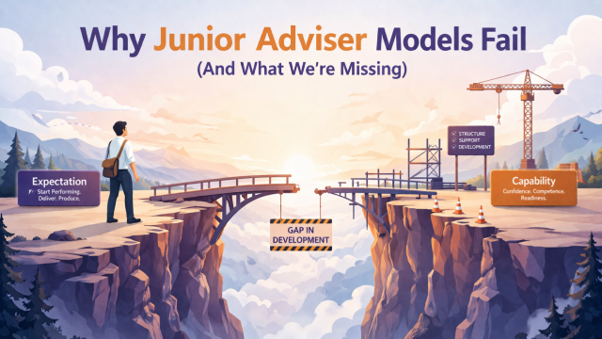
The result is that expectations sit ahead of capability. And no amount of pressure, incentive, or motivation fully closes that gap.
The “Unspoken Model” Most Practices Operate In
Very few practices would intentionally design a weak development model. But many operate within one – just not explicitly.
It tends to rely on assumptions like:
- exposure will naturally lead to competence
- responsibility will accelerate growth
- and that motivated individuals will “find their way”
Sometimes they do… But more often, progression becomes uneven and heavily dependent on the individual rather than the system around them. That’s where frustration starts to build from both sides.
Where Things Quietly Start to Break Down
One of the less visible challenges is how early-stage pressure is introduced. When individuals are expected to perform before they’ve had the opportunity to properly develop:
- confidence becomes fragile
- behaviour can become short-term focused
- and learning is replaced with coping
Over time, this creates a cycle where:
- the individual feels like they’re falling behind
- and the business feels like the model isn’t working
When in reality, the model was never fully defined to begin with.
The Missing Foundation: Starting in the Right Place
One of the most common mistakes I see is appointing a graduate and expecting them to step straight into an advisory role. On paper, it makes sense. In practice, it rarely works.
Many of these individuals are coming straight out of varsity. They haven’t just entered a new role, they’ve entered the workplace for the first time.
They are still learning:
- how to manage their time
- how to write a clear, professional email
- how to engage with colleagues and clients
- and how to operate within a professional environment
At the same time, they’re expected to:
- understand complex financial concepts
- engage with clients
- and begin producing at a level the business requires
It’s simply too much, too soon.
What tends to work far more effectively is a more structured progression:
- starting in an administrative role to build a strong operational foundation
- moving into a paraplanning role to develop technical depth and understanding
- and only then transitioning into an advisory role
This creates space for individuals to:
- settle into the working environment
- build confidence gradually
- and develop competence in layers
It also allows the business to guide, observe, and support development in a far more intentional way. Importantly, this progression should not be informal or assumed. It should be:
- clearly discussed
- properly documented
- and supported by defined deliverables and timeframes
That structure doesn’t limit growth, it enables it.
I’ve seen graduates move through this progression very quickly where they had the aptitude and drive. And I’ve seen others take more time. Both can be successful.
The difference is not the speed, it’s whether the pathway allows them to develop properly at a pace that is sustainable.
The Environment Matters More Than We Think
Development doesn’t happen in isolation. It’s shaped by:
- how exposure to clients is managed
- how feedback is given
- how responsibility is introduced
- and how support evolves over time
In practices where this is intentional, you tend to see:
- more consistent progression
- stronger confidence
- and better long-term retention
Not because the individuals are fundamentally different, but because the environment is.
What Stronger Models Tend to Have in Common
There isn’t a perfect model. But there are patterns in practices where this works well.
You’ll typically see:
- Clear progression pathways Not just titles, but defined stages of development
- Deliberate client exposure Moving from observation → participation → leadership
- Balanced early-stage support Where stability allows learning to take place before performance pressure dominates
- Clarity around roles and expectations So that both the individual and the business understand what success looks like at each stage
- Aligned remuneration at each stage Where incentives evolve alongside capability and responsibility
None of this is particularly complex. But it does require intention.
A Perspective From Experience
In my own work with financial planning practices, this is one of the areas where I most often see a gap between intention and reality. There is no shortage of willingness to invest in people.
But there is often less clarity on:
- how that development should be structured
- what the journey actually looks like
- and where responsibility sits at each stage
So what happens is that businesses try to solve for outcomes… without always having fully designed the system that produces those outcomes.
A Slight Shift in Focus
If we want to build sustainable advisory practices, and genuinely support the next generation coming into the profession, the focus may need to shift slightly.
From: “How do we get junior advisers to perform?”
To: “What have we actually built to enable that performance?”
Because when the system is clear, consistent, and well-supported… performance tends to follow.