May 25, 2026
One of the more interesting things about working with financial planning practices is seeing how businesses make decisions behind the scenes. Not the formal decisions that make it into strategy documents or management reports, but the real day-to-day decisions that shape how the business actually operates. And in many firms, those decisions are being made far more informally than people realise.
A conversation happens after a client meeting. Someone mentions an operational frustration in passing. A process changes because a team member found a quicker way of doing something. A decision is made in a meeting, but never properly documented or properly communicated afterwards.
At the time, none of it feels particularly significant. In smaller businesses especially, this often feels quite normal. The team is close knit, communication is constant, and decisions can be made quickly without layers of approval slowing things down. In the early stages of a business, that flexibility can even feel like a strength. But the problem starts emerging as the business grows.
Different people leave conversations with different understandings of what was decided. Teams begin applying processes inconsistently. Decisions become reliant on memory rather than structure. Eventually something goes wrong, and that is usually the moment where the real blind spot reveals itself. Because where there is no clear decision making structure, there is usually no clear accountability either.
When there is an operational failure, a client complaint, a missed task, or a breakdown in communication, businesses suddenly realise how unclear their internal accountability really is. People start saying things like:
- “I thought someone else was handling that.”
- “I didn’t know we had changed the process.”
- “I wasn’t aware that decision had been finalised.”
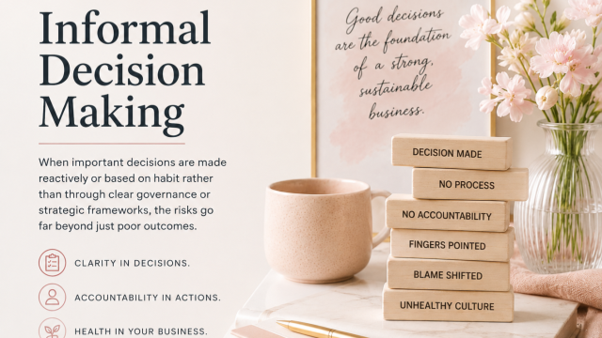
And before long, the focus shifts away from solving the problem and onto trying to determine who was responsible. Over time, this creates a very unhealthy environment inside a business.
Team members become hesitant to make decisions because they are uncertain about authority. Managers struggle to hold people accountable because responsibilities were never properly defined. Operational consistency starts slipping because different people are applying different interpretations of what was agreed.
One of the more damaging consequences is that trust inside the team slowly starts eroding. Frustration builds when people feel blamed for decisions they did not fully understand or were never clearly responsible for implementing.
This is something I see surprisingly often in financial planning businesses. Many practices grow organically over time without intentionally evolving their governance and decision making structures alongside that growth. Most firms begin with one founder making quick decisions and everyone adapting around them. That works reasonably well while the business is small and communication is informal. But once a business grows beyond a certain point, informal understanding is no longer enough.
The reality is that good governance is not only about compliance frameworks, board meetings, or formal policies. At a practical level, governance is often simply about creating clarity.
- What was decided?
- Why was it decided?
- Who approved it?
- Who is responsible for implementing it?
- And how is it communicated across the business?
Those questions sound simple. But when businesses cannot answer them consistently, operational risk starts increasing very quickly.
One of the biggest misconceptions around governance is that people assume it removes flexibility or slows businesses down. In reality, clear decision-making structures often create more efficiency, not less.
- Because people stop second-guessing.
- Teams stop operating on assumptions.
- And accountability becomes far easier to manage fairly.
The businesses that tend to scale well are usually not the businesses where one person controls every decision. They are the businesses where people understand:
- How decisions are made.
- Who is accountable.
- And where responsibility begins and ends.
That clarity changes the way businesses operate.
So perhaps the real question for business owners is this: If something went wrong in your business tomorrow, would it be completely clear who made the decision, who approved it, and who was responsible for implementing it?
Because often the businesses that feel the most chaotic are not lacking good people. They are lacking clear accountability. And clear accountability rarely exists without clear decision making.