July 8, 2026
In many financial planning firms, when something goes wrong, the first instinct is often to blame the process. The process is too slow. The process is too complicated. The process needs updating. The process is not being followed. And sometimes that is true. Processes do become outdated. Systems change. Compliance expectations shift. Client expectations evolve. What worked three years ago may no longer be fit for purpose.
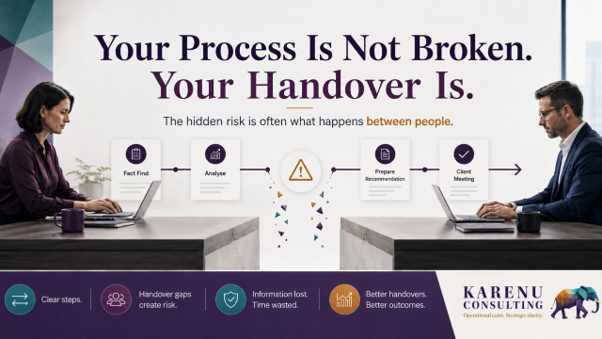
But in many firms, the process itself is not always the real problem. The real problem is what happens between people. More specifically, what happens when work moves from one person to another. The handover. That small, ordinary, easy-to-underestimate moment where responsibility is supposed to transfer clearly from one person to the next. The adviser to the paraplanner. The paraplanner to the administrator. The administrator to the provider. The provider back to the administrator. The administrator back to the adviser. The adviser back to the client. And somewhere in that chain, work quietly disappears into the operational mist.
Nobody meant to drop the ball. Nobody woke up that morning and thought, “Today feels like a good day to create unnecessary delays, frustrate a client, and irritate the Operations Manager.” And yet, there it is. The task that was assumed to be with someone else. The email that was forwarded without context. The case that was waiting for information, but no one was clear who was supposed to chase it. The client query that was “being dealt with”, which turns out to mean four different things depending on who you ask. The review pack that was almost ready, except for one missing piece of information that everyone thought someone else had requested.
This is where good work gets stuck. The process may look perfectly sensible, but if the handover is vague, the work still disappears into the gap between people.
The handover gap is where operational risk hides
In financial planning, work rarely sits neatly with one person from start to finish. Client work moves through multiple roles, systems, checks, approvals, and external parties. That is normal. But every movement creates a risk point. Every time work passes from one person to another, there is a chance that something important may be missed, misunderstood, delayed, duplicated, or assumed. The more complex the client journey, the more important the handovers become.
A process map may show a beautiful sequence of steps. It may look clean, logical and perfectly sensible on paper. But the real test is not whether the process looks good in a document. The real test is whether everyone knows what must happen when the work leaves their hands. Who owns the next step? What information must be included? What does “complete” mean at this stage? What happens if something is missing? Who updates the client? Who monitors the deadline? Who is responsible if the external provider has not responded? Who has authority to escalate? These are not small details. These are the details that determine whether the process actually works.
Without clear handovers, a firm can have perfectly acceptable written procedures and still experience constant delays, rework, frustration, and client service issues. The process exists. The work still gets stuck.
“I thought they were dealing with it”
This may be one of the most expensive sentences in operations. It sounds innocent enough. And often, it is. Most people are not trying to avoid responsibility. They are working from assumptions. The adviser assumes the administrator is chasing the provider. The administrator assumes the paraplanner is waiting for the adviser’s sign-off. The paraplanner assumes the adviser knows the file is waiting on missing client information. The adviser assumes the client has already been updated. The client assumes nothing is happening. And the Operations Manager assumes a migraine is incoming. Sensible, frankly.
The difficulty is that assumptions are rarely visible until something goes wrong. By the time the gap is noticed, the firm is already in recovery mode. Someone has to investigate what happened, reconstruct the timeline, calm the client, chase the missing item, and usually create a workaround. This is exhausting for teams and risky for the business. It also creates a culture of chasing. And chasing is not a workflow system.
If your process depends on the Operations Manager remembering to follow up with everyone, the process is not properly controlled. It is being held together by someone’s memory, persistence, and tolerance for inbox archaeology. That may work for a while. It may even work very well when the firm is small, the team is stable, and the key people know each other’s habits. But it does not scale. It also does not survive pressure very well.
A handover is not the same as passing something on
One of the reasons handovers fail is because people confuse forwarding something with transferring responsibility. Sending an email is not automatically a handover. Dropping a note into the CRM is not always a handover. Mentioning something quickly in a meeting is definitely not a handover, especially if no one records the action properly. A proper handover should make the next action obvious. The person receiving the work should understand what has been done already, what still needs to be done, what information is missing, what decision is required, what deadline applies, what the client has been told, what risks or sensitivities exist, where the supporting information can be found, and who owns the next action.
This does not need to become a bureaucratic monster. Nobody needs a 12-page handover note for every task. That way lies madness, and probably another meeting. But there does need to be enough clarity for the next person to act without having to decode the situation from scratch. A good handover reduces friction. A poor handover creates detective work. And in many firms, far too much operational time is spent on detective work.
The hidden cost of poor handovers
Poor handovers are not just irritating. They are expensive. They create delays because the next person cannot act confidently. They create duplication because someone repeats work that has already been done. They create rework because information was incomplete or misunderstood. They create client frustration because updates become inconsistent or delayed. They create compliance risk because key steps may not be evidenced properly. They create team tension because people start blaming each other for gaps that were never properly designed out of the workflow.
They also drain the Operations Manager. Because when handovers fail, operations usually becomes the place where the problem lands. The Ops Manager becomes the interpreter, the chaser, the fixer, the historian, the traffic controller and, occasionally, the emotional support human for everyone involved. That is not sustainable. It is also not the best use of an Operations Manager’s time. Operations should not exist merely to rescue poor workflow design. Operations should help build the structure that makes rescue less necessary.
What good handovers look like
A good handover is not complicated. It is clear. It answers the question: “What does the next person need in order to move this forward properly?” That sounds simple, but it requires discipline. Good handovers tend to be specific enough that the next person knows what action is required. They give enough context so that the person receiving the work does not have to piece together the story from a cryptic email chain and three half-updated system notes. They are visible somewhere appropriate, not trapped in someone’s memory or buried in a private inbox. They make ownership clear. They include the relevant deadline where timing matters. They make sure the receiving person has access to the documents, information and background needed to act.
The best handovers reduce the number of unnecessary follow-up questions. Questions are useful when they add judgement, context or challenge. They are less useful when they are only needed because the handover was too vague. If every handover requires the next person to ask, “What exactly do you need me to do with this?” then the handover has already failed its first basic test.
The Operations Manager’s role in fixing the handover gap
Operations Managers are often in the best position to spot where handovers are failing. They see the recurring delays. They know which cases regularly get stuck. They know where advisers tend to provide too little context. They know which admin tasks bounce back because information is incomplete. They know which provider processes require extra monitoring. They know where compliance checks happen too late. They know where the CRM says one thing, the email trail says another, and the client thinks something else entirely.
This visibility is valuable, but spotting the problem is not enough. The next step is to convert recurring frustration into better operating structure. That may mean creating clearer trigger points for when work moves from one role to another. It may mean defining what information must be included at each handover. It may mean building simple handover templates for recurring workflows, clarifying ownership when work is waiting on third parties, making case status visible in one agreed place, reducing reliance on inboxes as the main source of truth, agreeing escalation points when deadlines are missed, and reviewing where work regularly gets stuck.
This is where operations becomes strategic. Not by adding more admin for the sake of it, but by removing avoidable confusion from the business.
Do not fix every handover at once
One practical warning: do not try to fix every handover in the firm at the same time. That is how good intentions become another abandoned project. Start with one workflow that regularly causes friction. New business. Annual reviews. Client onboarding. Provider chasing. Letters of authority. Fee changes. Implementation after advice. Pick one area where the team already feels the pain. Then map the actual handovers, not the theoretical ones.
Ask where work moves from one person to another. Ask what information is usually missing. Ask where people make assumptions. Ask where delays usually occur. Ask where the client experiences silence. Ask where the Operations Manager usually has to step in. Ask where ownership is unclear. Once you can see the pattern, improve that specific handover. Make the next action clearer. Make ownership visible. Make the required information explicit. Make the status easier to track.
Then test it in practice. Not in a boardroom. Not in a policy document. In real work. If it helps the team move work forward with less confusion, keep it. If it creates unnecessary admin without solving the problem, adjust it. Processes should serve the work, not become decorative wallpaper.
Better handovers create better businesses
A firm does not need perfect people to operate well. It needs clear enough structures to help real people work properly under pressure. Because people will be busy. They will be interrupted. They will forget things. They will misunderstand instructions. They will assume something is obvious when it is not. They will work from inboxes, habits and shortcuts unless the business gives them a better way. That is not a character flaw. It is operational reality.
Good handovers help protect the business from that reality. They make work easier to pick up, easier to track, easier to complete and easier to evidence. They reduce the need for constant chasing. They improve the client experience. They reduce friction between teams. They help Operations Managers move away from daily firefighting and closer to proper operational leadership.
So, before rewriting the entire process, ask a better question: is the process really broken, or is the work simply getting lost between people?
Because sometimes the biggest improvement is not a new process. It is a better handover.