July 2, 2026
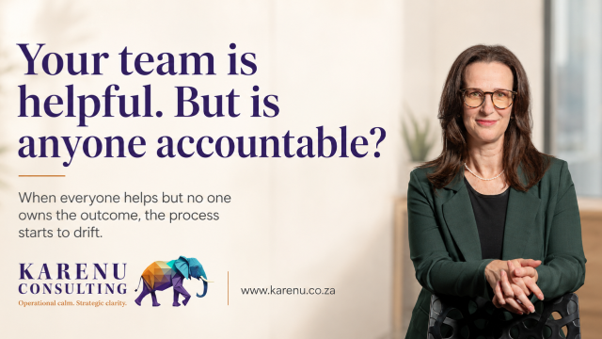
Helpful teams can still create fragile processes when ownership is unclear.
In many financial planning practices, work does not fall through the cracks because people do not care. Quite often, it falls through the cracks because too many people care, too many people help, and nobody is completely clear on who actually owns the follow-through. That sounds harmless at first…
In a busy advice business, people naturally step in where they see a gap. The administrator follows up with the client. The adviser checks whether the form was signed. The practice manager reminds someone about the outstanding requirement. Compliance asks for the missing evidence. Someone updates the spreadsheet. Someone else makes a note in the CRM. A WhatsApp gets sent. A second WhatsApp gets sent. Then someone says, “I thought this was already done.”
And there it is… The process did not fail because the team was lazy. It failed because the business was relying on helpfulness instead of ownership. There is a big difference between helping with a task and owning an outcome.
Helping says, “I will assist where I can.”
Ownership says, “I am responsible for making sure this moves forward, that the right people do what they need to do, that the evidence is where it should be, and that the matter does not disappear into the operational Bermuda Triangle.”
Most practices think they have ownership because they have roles, job descriptions or process documents. But when you follow the work in real life, the picture is often less clear:
- Who owns the client onboarding process from start to finish?
- Who owns the follow-up when a client has not returned documents?
- Who owns checking that advice records are complete before implementation?
- Who owns making sure internal approvals happen before the client experience is affected?
- Who owns the handover between adviser, administrator, paraplanner, operations and compliance?
- Who owns the “this is stuck and someone needs to make a decision” moment?
If the answer changes depending on who you ask, the issue is not the process document. The issue is unclear ownership. This is where practices start to feel operational drag. Tasks are repeated because nobody is sure whether someone else has done them. Follow-ups become informal. Escalations happen too late. Clients wait longer than they should. Evidence is collected after the fact. Key people become bottlenecks because everyone knows they are the ones who will remember, chase and fix what others missed.
That may work for a while. Especially in a small, committed team. But as the practice grows, the cracks widen. A business cannot scale on memory. It cannot rely on goodwill as its operating model. It cannot treat “someone will probably pick it up” as a control. That is not operational resilience. That is hope in a blazer.
Clear ownership does not mean creating a rigid, over-engineered environment where nobody helps outside their lane. Financial planning practices need collaboration. But collaboration works best when ownership is clear.
The question should not be, “Who can help with this?”
The better question is, “Who owns making sure this gets done properly?”
That owner does not need to do every step personally. But they do need to know where the work is, what is outstanding, who needs to act, what the risk is, and when something must be escalated.
This matters for more than efficiency. It affects client experience, compliance, staff pressure, business continuity and the ability of the practice owner or management team to see what is actually happening in the business.
When ownership is unclear, problems become personal. People get blamed for missing things that were never properly assigned. The reliable people carry more than they should. The quiet fixers become invisible risk controls. The business thinks the process is working, but in reality, it is being held together by a few people who have learned to compensate for the gaps.
That is not fair on the team. It is also not sustainable for the business. A useful test is this: If the person who usually remembers, checks, reminds and quietly rescues the process were unavailable for two weeks, what would stop moving? That answer tells you where your ownership gaps are.
It may show you that the problem is not a lack of process. It may show you that the problem is unclear handover points, vague accountability, informal escalation, too many duplicated checks, or no single person responsible for the outcome. And that is fixable. But only once you stop treating the symptom as the problem.
Another checklist may help. Another training session may help. Another reminder may help for a week or two. But if ownership is unclear, the same issues will keep returning in slightly different outfits.
Financial planning practices do not need more operational noise. They need clarity around who owns what, where work moves, where it gets stuck, and how issues are escalated before they become client, compliance or staff-pressure problems.
When everyone is helping, but no one owns it, the business may still look functional. But under the surface, the process is fragile. And fragile processes have a habit of waiting until the worst possible moment to introduce themselves properly.